Why don't ugly stores sell? The role of "premium design" in building trust.
Maksymilian Rybicki
on
January 22, 2026
Inspirations
In an era where consumers are bombarded with thousands of offers daily, design has ceased to be just a "packaging". It has become a proof of identity.
In the world of e-commerce, trust is the hardest currency. You can have the best product and brilliant marketing, but if your store looks like "a $9 template from 2018," you’ve lost from the start. In an age where consumers are bombarded with thousands of offers daily, design has ceased to be just "packaging." It has become proof of identity.
Not long ago, there was a belief that at the beginning of a business, "quality doesn’t matter," and "only the product counts." It's one of the most harmful myths in the history of online commerce.
Behavioral psychology is ruthless. A customer entering your site does not read your mission or terms of service. They visually scan the space. If they encounter chaos, unreadable typography, or an outdated layout, their brain sends a warning signal: "This is not a safe place."
The 50 Millisecond Rule
Research on UX in e-commerce is unequivocal: users form an opinion about the credibility of a site in about 50 milliseconds (0.05 seconds). That's faster than a blink of an eye.
In that split second, an emotional decision is made, which the customer then rationalizes. If your store looks professional, clean, and modern (the so-called Apple or Linear aesthetics), the customer subconsciously assumes: "Since they care about visual details, they surely care about the quality of the product and the safety of my data."
However, if the website looks cheap, "customer trust" drops to zero. By 2026, an "ugly" store is synonymous with risk, lack of support, or even fraud (scam) for consumers.
The End of the Era of “Generic Templates”
For years, small businesses were doomed to ready-made templates. The result? Thousands of stores looked identical. They were functional, but dull and lacking character. Worse, they were often overloaded with unnecessary elements that only distracted attention.
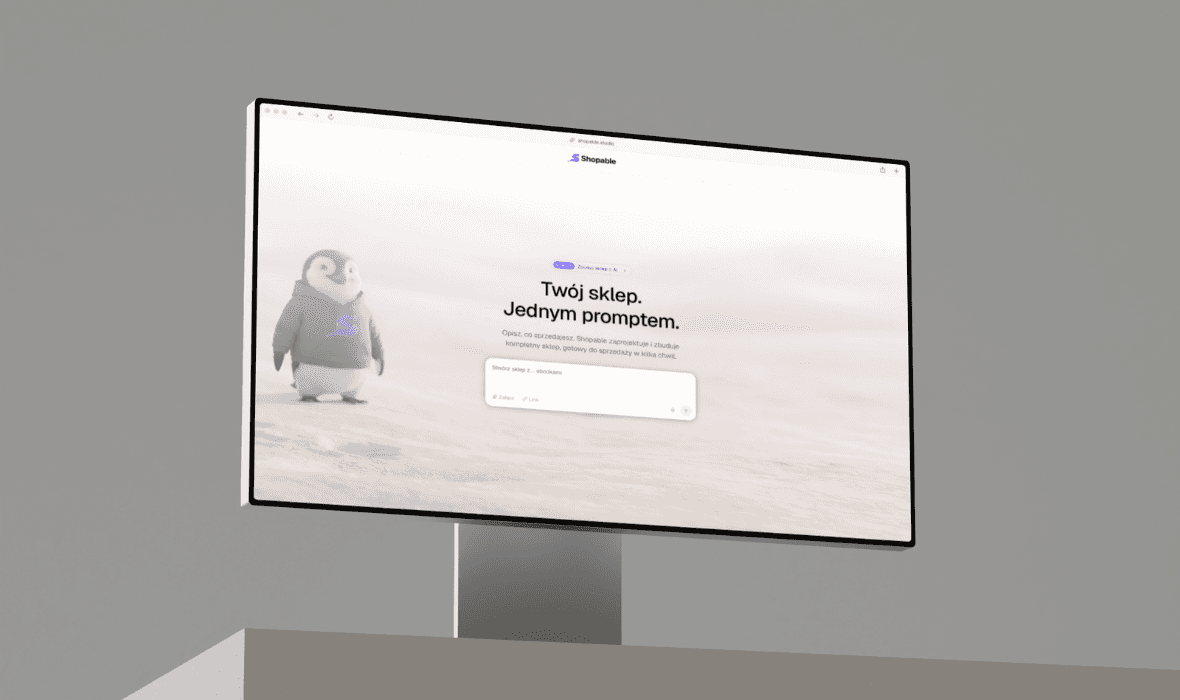
Today, thanks to tools like Shopable, we are entering the era of AI store design.
Artificial intelligence does not “choose a template.” It understands the context of your brand. If you sell luxury jewelry, the AI will generate a lot of "white space," elegant serif typography, and minimalist navigation. If you sell gaming equipment – the interface will be dynamic, dark, and sharp.
This is the end of compromises. You get a webshop design at the level of a top creative agency from New York, but without an invoice for tens of thousands of dollars.
What Does “Premium Design” Mean in 2026?
Luxury in the digital world no longer means gold frames and complicated animations. In 2026, "Premium" means:
Clarity: No unnecessary stimuli. Focus solely on the product.
Speed: The interface must respond instantaneously. Any delay shatters the illusion of professionalism.
Consistency: Colors, fonts, and layout must create a harmonious whole.
This is the standard being set by tech giants, and it’s the standard customers have become accustomed to. Shopable democratizes this level of quality. With Generative UI engines, every budding entrepreneur receives "High-End UX" as standard.
Your site no longer looks like an amateur project done "after hours." It looks like a mature, stable business.
Design is Not an Expense, It's an Investment
An old truth says: "How you are seen is how you are written." In e-commerce, it goes: "How you are seen is how you are paid."
Customers are willing to pay a higher margin in a store that inspires trust with its appearance. Premium aesthetics suggest a premium product.
By 2026, you don’t need to hire a team of graphic designers to achieve this effect. Technology has leveled the playing field. AI tools have made "great design" no longer a privilege of the largest corporations. It has become a standard available to anyone brave enough to type a prompt and start selling.
Remember: Your store is your only storefront. Make sure it invites people in, not sends them fleeing.
Previous article: